
How to do multi-shuttle feeding in badminton - Beginner’s guide
1. Intro
There are many ways to improve your badminton, and one of the most effective is multi-shuttle feeding. Unlike normal rally practice with one shuttle, multi-shuttle feeding allows you to train specific movements, patterns, and intensity levels. This is a type of training in which you use a row of multiple shuttles in your arm to feed these to a player doing the exercise (multi-feeding). This way of training has its benefits and drawbacks compared to regular one shuttle training and playing a rally (rally-feeding).
This article will explain exactly how to do it and how to minimize the downsides so you make the most out of your training. At the end of this article, you will find a few example exercises. So if you want to learn how to get the most out of multi-shuttle feeding, you are in the right place.
2. Multi-feeding vs rally-feeding
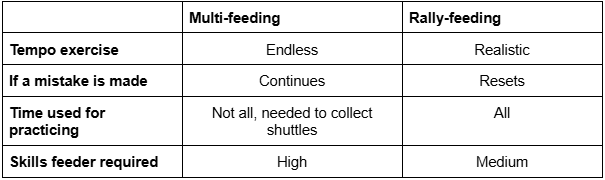
As mentioned there are some upsides and downsides for both rally-feeding and multi-shuttle feeding. And there is a time and place for both if you want to improve your game. Rally-feeding is overall more achievable for most players and locations, and is the most realistic way to train for a match. However, if you want to train repetitive patterns or work at a higher tempo than in a match, multi-shuttle feeding is a great solution
One downside of multi-shuttle is that time is needed to collect the shuttles, while with a rally exercise both players are continuously playing. If you could only pick one, pick rally-feeding. But if you have the options, add some multi-feeding in your weekly program.
However, multi-feeding can be a great solution if you cannot find players to play against at the level you are looking for. With multi-shuttle feeding you can practice above the level of the feeder normally can offer.
Below is a table that summarizes the main differences.
3. How to multi-feed
Step 1: make a row of shuttles that you comfortably can hold in your arm, with the shuttles pointing towards your hand. This will be for most players between 10 and 25 shuttles.
Step 2: take the shuttle by the tip with your middle finger and thumb on your racket hand, whilst still holding the racket properly.
Step 3: Toss the shuttle slightly upward and in front of your racket side, so you can strike it comfortably with a controlled swing.
Step 4: hit the shuttle with the same arm you just threw with, in a controlled motion pointing towards where you want the shuttle to go. Make sure you hit the tip of the shuttle and not the feathers.
Step 5: repeat until the row is finished.
4. Where to feed?
You might think that's all there is to know right? Not so fast!Besides knowing how to hit the shuttles, you should know where to feed the shuttles towards.
Sometimes the exercise might be very limited, and your options are already predetermined on where to hit it. In this case, focus on the quality in height and depth mostly. And vary this if that is what the player needs/wants.
If the exercise is more open, your (tactical) skills come into play. For every shot, look at the shot the player just played before. Where did it go and what was the quality? If the opponent plays a quality smash down the line, the next shot of the feeder will not be a smash to the other side.This is basically impossible in a match, and also ruins the effectiveness of the exercise. Always try to play a realistic return from the imaginary opponent on the shot that was just played. This does not mean always playing it where the player expects it, but having some limited options or only making an exception from this rule once in a while. This keeps the exercise flowing, and also keeps the player thinking on where to move next. This also means in terms of quality: bad quality? This may lead to a fast body shot in return. So the player learns when the shot was good and when it was not.
5. Where to stand?
It is not only important where you feed the shuttle, but also where you feed it from.
Try to think about what side of the court you are doing the multi-feeding. Since playing a cross sliced shot is different on a cross lift than a straight lift for example. The direction of the shuttle matters. You can vary this by moving around on court while doing the multi-feeding, or by changing backhand to forehand hitting and vice versa depending on the side of the body you want to play the shot from. Keep in mind this addition to make the exercise even better, but the moving around or hitting backhand multi-feeding should not be in the way of the quality in the first place. So keep it simple if you are just starting out.
6. How many shuttles?
The great thing about multi-shuttle feeding is that you can make the exercise as long or short as you would like. If you want to replicate The longest badminton rally ever in a match , you get yourself 106 shuttles and get going. There is no right or wrong. But it helps to pick an amount you can comfortably hold in your hand, and doing 2 or 3 repeats in a row of this. Depending on your size and skill this will most likely be between 10-25 shuttles per row.
For technical exercises, you can do a lot more rows in one go, while doing a very tough cardio exercise, you most likely fatigue after a few good rows at high intensity. Besides this, you can do a hybrid version between rally and multi exercises by playing the shuttle a few times back and only after a finishing shot from the player starts with a new shuttle. Just experiment what works for you, ask some coaches or check the examples of training at the bottom of this article!
7. Additional equipment
It can be nice to have some additional equipment to make multi-shuttle feeding easier.
Broom
Get a large broom, and after each session when you want to collect the shuttles you can whip them together. This makes it easier for you to collect them and you do not have to move around the court all the time. Saves time -> More time spent training
Video camera + stand
You can do many exercises with multi-feeding, and you can make very isolated situations. But what exactly is going wrong in your technique? This is very hard to notice while feeding or while running around. Get yourself a camera and set it up, so you can watch back your session and improve like this.
Extended tube
Sometimes it might be nice to do longer rows without break. Your arms can only hold so much. To upgrade, you can get yourself a long tube which holds shuttles. This can be easily self-made. Get yourself a long PVC tube with a diameter of XX, and on one end, narrow the gap with some foam or a smaller ring of PVC. Make the end opening around XX, so the shuttles do not fall out but can pass through if being pulled a bit.
8. FAQ
Is multi-feeding better than rally-feeding?
No, both have their own place and if you can only pick one, pick rally-feeding.The shuttle keeps tumbling when I try to hit the shuttle, and it goes in all directions. Why is this?
Most of the time, this is because you are not tossing the shuttle nicely upwards in a big movement, but you are dropping it down and you have no time to react.Can you become a great player without multi-feeding?
Yes, certainly, but I think it helps you along the way and I also think EVERY elite level player does multi in their program. I think that says a lot.
9. Example exercises
Here are a few simple examples of exercises to do, but please keep in mind the possibilities are endless:
High intensity exercise: Feeder plays a lob to the forehand rear corner, the player answers with a smash or drop on either side.The feeder plays a short shot if a drop is played on the side where the drop is played.If a smash was played, the feeder plays a drive on the side the smash was played towards. If the quality of the drop was bad, you can play a fast shot to the body of the player.
Hybrid exercise: You feed 1 shuttle to the middle of the court, and the player plays it back to the feeder.Feeder CONTINUES with the same shuttle, and can choose to play it back to the player in the middle again, or lift it to either side. If played to the player, the player plays it back at the feeder, if lifted to either side, the player plays a smash to the line. This will start a new cycle with a new shuttle from the feeder.
Technical exercise: the feeder lobs shuttles 1 by 1 to the back where the player is standing. The player practices hitting the shuttle high and making the right dropshot technique.
10. Conclusion
Multi-shuttle feeding is one of the best ways to practice specific parts of the game, or training at very high intensity. It can complement rally-feeding very well during your training schedule. And make sure you practice feeding as well, since it will not go perfect in the first attempt, but being a good feeder also takes time and dedication.
That’s really all you need to know about multi-shuttle feeding.
If you want more tips to improve your badminton, check out the other guides on the site!
